Broadening Horizons in the Baltics: Baltic Sea Cruise Part Two

It's finally time! 19 months ago, I booked this Baltic Cruise at its cheapest rate with the goal of visiting as many European countries as possible during our tour in Rota, and now it's time to cash in on my far-out planning!
September 7: Boarding the Cruise
We started our morning by watching the sun rise while we dragged our luggage to the tram station near our Berlin hotel.
Berlin Central Station: Berlin Hauptbahnhof
We made it to the city's main train station for our 7:36 am ride to the northern German coast to meet our cruise ship in Rostock, Germany. We wondered how this cruise port was considered "Berlin" when it took us nearly three hours to reach our destination, but hey, we made it to our MSC Poesia cruise ship before lunch! Let the cruise commence!
Warnemünde Cruise Center: Rostock Pier 8
After working our way through the boarding process, we were quick to start our cruise with a drink in hand and an attempt at ping-pong and foosball! Eventually, we met up with RJ and Aidan for a game of cards as the ship left port!
September 8: Gdansk, Poland
French wharf: Nabrzeże Francuskie
Our first cruise port brought us to Gdansk, Poland! Bryan and I visited Krakow earlier this year and loved the Polish vibes, so we were looking forward to another visit to Poland.
Green Gate: Zielona Brama
It took us longer than expected to get from the cruise port to the city's center, so we missed the first 20 minutes of our walking tour. Luckily, we were able to find our tour and join in!
Crane: Żuraw. Oddział Narodowego Muzeum Morskiego
We started our tour by spotting the city's old wooden crane. Built in the 1500s, this Medieval crane was damaged during WWII, but was refurbished based on historical records. This crane may be old, but it could lift 4,000 lbs of cargo 40 meters in the air- a true engineering feat from the 16th century.
Kładka Grzegorza: Kładka Św. Ducha na Wyspę Spichrzów
While the crane represents the Medieval history of the city, the bridge represents the modern engineering talent of the city. Rotating every 30 minutes to allow boats to cross, this pedestrian bridge cost 10 million Polish zloty (2.8 million USD) and was designed by a Polish engineer!
Golden Gate: Brama Złota
The city of Gdansk has several gates leading into the old town center. We passed through the Green Gate earlier to find our tour group, and then later passed through the Golden Gate to see the rest of the city.
Fahrenheit's meteorological column: Kolumna meteorologiczna Fahrenheita
Fun fact: Daniel Gabriel Fahrenheit was born in Gdansk and began his experiments for developing a reliable thermometer right here in his childhood home, Dom Urodzin Fahrenheita. The city has one of Fahrenheit's earliest thermometers on display, even though they have adopted the Celsius scale along with the rest of Europe!
St. Mary's Street: Ulica Mariacka w Gdańsku
Saint Mary's Street is one of the oldest streets in the city. After its destruction during WWII, engineers and artists came to Gdansk in the 1980s from Ukraine and Warsaw to rebuild their lives and try to recreate Gdansk to its prior beauty. Nowadays, the street resembles its 17th-century origin and is still known for all the amber jewelry shops.
Our tour guide taught us a little about amber: it is formed by hardened tree resin and is famously found all over the Baltic Sea due to a giant "amber vein" that was found at the bottom of the sea. Amber floats in salt water and can be found on the beaches since it washes up after storms!
St. Mary's Church: Bazylika Mariacka Wniebowzięcia Najświętszej Maryi Panny w Gdańsku
Our tour continued to the church at the end of Saint Mary's Street, named accordingly Saint Mary's Church! Seemingly basic from the outside, the church contains an impressive 40 m high clock from the 14th century that showcases all twelve apostles and a grim reaper, meant to symbolize the coming judgement day. As the 12 disciples make their way around the clock, the door shuts in front of death, symbolizing that death can’t enter paradise. This is the second-largest wooden clock inside a cathedral in the world, with the largest located in Strasbourg, France.
Neptune's Fountain: Fontanna Neptuna
As we ended our walking tour in Gdansk, our final stop was at Neptune's Fountain in the center of Old Town.
With our first port call ending, we boarded the ship and enjoyed an evening of dinner and a show!
Tonight's performer was a "sand artist," and my curiosity got the better of me! Bryan and I were mesmerized by this art, and I caught myself wondering: how does one discover they have the "sand art" talent?
September 9: Klaipeda, Lithuania
Our second port call of the cruise brought us to a new country: Lithuania! As we disembarked to join our tour bus, we were greeted with traditional music!
Bryan almost left me while I stopped to film the local welcome sounds!
Looking back on the entire cruise, this day's tour was one of our favorites! Our guide, Antanas, started by explaining that Lithuania is the same size as West Virginia and became an independent country in the mid-13th century. They developed their own language, culture, and customs alongside their neighboring Baltic countries: Latvia & Estonia.
Lithuanian is one of the world's oldest written and spoken official languages. Lithuanian is nothing like Slavic, Latin, or Germanic languages; it is rooted in Indo-European languages from the continent's first nomads and actually has the closest ties to the spoken Korean language.
In 1795, Lithuania was conquered by Imperial Russia, where they weren’t allowed to teach or even speak their language for over 51 years. They gained independence at the end of WWI, but Russia didn't stay away for long, and they were occupied again in 1940.
While the rest of the world was focused on WWII and the Nazis, Lithuania and the rest of the Baltic countries suffered under Soviet rule. (We will cover more about that tomorrow in Latvia!)
For today's tour, we focused on the Soviet occupation and the Cold War times. Lithuania became a hotbed for nuclear warheads during the Cold War, with its strategic location closest to Europe. While Tucson, Arizona, and Ukraine were homes to nuclear warhead launch sites above ground, the first Soviet underground nuclear missile launching site in the world was actually here in Lithuania- and we got to tour it today.
We arrived at the underground nuclear rocket facility, Plokštinės pažintinis takas, and enjoyed learning more by visiting the Cold War Museum, Šaltojo karo muziejus.
As we headed underground into the missile launch facility, we learned that this site opened on December 31, 1962, and was built underground with the hopes of going unnoticed by the rest of the world. It worked for three years, but was discovered by American spy planes in 1965.
While no rockets were ever launched from this site, they had the potential to launch rockets that could reach Istanbul, London, Madrid, Rome, Berlin, or Paris. The Soviet rockets could travel at 2 km/s and could reach Madrid in 13 minutes. With the discovery of this launch site, all of Europe was on high alert.
This facility contained four underground silos holding four ballistic missiles each and was guarded by 300 soldiers. While most soldiers were above ground, 32 were stationed underground and worked in two shifts to always be ready for a launch order.
In 1968, this base received orders from the Kremlin to prepare the launch of rockets towards Prague. The Czechoslovakian people were protesting Soviet occupation at this time, and the Russian government wanted to send a message to all of their territories that uprisings would not be tolerated. We were able to see diary entries from officers in the bunker during this hostile time that describe the scene. Apparently, it was just like what we see in the movies: keys had been inserted, officers were dripping sweat and awaiting the final phone call to push the red button, which thankfully never came.
We also learned that some of the warheads that were taken to Cuba during the Cuban Missile Crisis actually came from this base.
After touring the museum portion of the facility, we entered one of the four silos. While empty today, all four silos held active rockets throughout the Cold War. The ceilings of these silos would rotate open and could launch rockets within 12 minutes of notification from the Kremlin.
Knygynas VAGA
Having a grasp on Cold War history, we boarded the bus and made the journey back to Klaipeda (clay-puh-duh).
Our guide was kind enough to drop us in the city center, since we had some time before we had to return to the ship. Our one goal was to find a bookstore! Lucky for us, Bryan had done some research on the drive back to Klaipeda, and we found a copy of Harry Potter and the Philosopher's Stone in Lithuanian, which came in a brand new cover for our collection!
Theatre Square: Teatro aikštė
Our final sightseeing in Lithuania was a quick stop in the Theater Square, where Hitler gave a famous speech from the theater balcony in 1939. While exploring this small city's streets, we made sure to pick up souvenirs for both of our parents and then returned to the boat!
Bryan and I stumbled upon a hidden deck at the front of the ship that was the perfect spot to watch us leave port and see the sunset. What a perfect end of the day!
September 10: Riga, Latvia
Another day, another port! Welcome to Latvia!
RIGA sign with Cat
As we wandered the city's streets, we learned that Latvia won its first-ever Oscar with the animated film "Flow" at the 2025 Academy Awards for Best Animated Feature Film. This cartoon follows several animals amidst a flood, and tells the story without any dialogue! Bryan and I need to watch it when we get home, especially after spotting giant RIGA signs around the city boasting the film's characters!
Zvaigznes grāmatnīca
A new country with a new language means another bookstore visit! We lucked out by finding a Latvian copy of the first Harry Potter book in our first bookstore visit!
Today's two tours focus on Latvia's occupation by the Soviet Union. We started by visiting the Museum of the Occupation of Latvia, which gave a great overview of its history of occupation over the years.
Museum of the Occupation of Latvia: Latvijas Okupācijas muzejs
In June 1940, Latvia fell to the Soviets while the rest of the world was watching the Nazis' invasion of France; with everyone distracted by the Nazis, the three Baltic states fell to communist rule without anyone blinking an eye.
Under the Soviets' rule, anyone with more than the equivalent of 10,000 Soviet rubles in savings had their money confiscated for "equal sharing." A majority of these wealthy families were Jewish- they had fled from Eastern European countries and thought the Baltic States would be safe.
Before long, the Soviets forced Latvian Jews into ghettos. Once the ghettos were overcrowded, Latvian Jews were taken to forests, murdered, and dumped in massive graves because it was 'cheaper' than shipping them to work camps. Of the 19,000 Latvian Jews, only 2,000 survived this massacre.
At the same time, more than 200,000 Latvian men were forced to join the socialist army. In retaliation, more than 12,000 loyal citizens joined partisan groups to resist the Soviets and fight communism.
Joseph Stalin, an ethnic Georgian, began training to become a Russian Orthodox priest at the age of 16. He left the seminary at the age of 21 and became a gangster, robbing banks and stagecoaches to raise money for the Bolshevik movement; the supreme leader of Soviet Russia was literally a thug. People think of the horrors Hitler incited against ethnic groups, mainly the Jews, murdering nearly 11 million people during the Holocaust. During Stalin's rule, nearly 20 million people were killed in his Gulag system alone; this doesn't include the tens of millions who died from famines caused directly by his political policies.
Under the rule of Stalin, numerous work camps (known as Gulags) were established around the country, predominantly located in the far east (Siberia). Many of these work camps didn't even have guards because they were located over 1000 kilometers from the nearest town. During Stalin's rule, the Soviets sent over 60,000 Latvians to Siberian work camps. In 1953, following the death of Stalin, the new leader of the Soviet government, Nikita Khrushchev, closed many of these forced labor camps.
Nearly 170,000 Soviet troops occupied Latvia during the 1980s in an effort to maintain control of the working class. Before the invasion, Latvia's economy was predominantly agricultural; following the invasion of the Soviets, industrialization of the cities took place. Nearly 80% of the food grown and goods produced in Latvia were sent to Russia or other Soviet-controlled territories.
Iceland was the first nation to recognize Latvia as its own sovereign state. Latvia joined the European Union and NATO in 2004; we learned that Putin actually wanted Russia to join NATO in 2000, but they never submitted a formal bid.
In 2006, Latvia cancelled the required military service for all males, but following the Russian invasion of Ukraine in 2022, they have greatly increased its defense budget and border fortifications. Today, Lithuania and Finland have completely closed their borders to Russia, but Latvia and Estonia have limited areas on land, where crossing is still possible.
The Corner House: Stūra Māja
After a heavy visit to the Museum of the Occupation of Latvia, we headed to our second museum of the day: The Corner House. Built in 1912, its original purpose was apartments and shops. When the Soviets invaded Latvia in 1940, the building was primarily used as a KGB (known as the Cheka) office and political prison. The first rooms we visited were used for processing criminals and interrogations. The KGB would use physical and psychological torture or threats as a means to force a confession from locals who were thought to support local resistance groups.
Deeper into the building, we visited numerous holding cells. There are 44 cells throughout the building, housing an average of 20 prisoners each, totaling up to 900 prisoners inside the building. Each cell was tiny, making it standing room only. Sanitary conditions were terrible, as there was no opportunity to use the bathroom except for the small chamber pot inside each cell.
As we neared the end of our tour, we learned that the political prisoners were given 15-20 minutes of exercise time in the "yard." Prisoners from different cells were not allowed to interact with one another, as this could give them a chance to conspire together.
The final room we visited was used for executions. Historians know that AT LEAST 188 prisoners were murdered in the building in 1941 alone, but that it could be even higher. The primary means of execution was shooting in the back of the head. The bodies were then loaded onto a truck and buried in unmarked graves outside the city.
Unlike most museums we have visited, the Corner House has not been formally restored and promoted for tours. Instead, the walls are decaying and mold is present- just as it was back during Soviet times. We literally stood where hundreds of prisoners stood.
Cat House: Kaķu nams
Whew! That's a lot of history for one day!
With a little time remaining in Latvia, we visited the famous Cat House that showcases metal cat statues on the roof. All the touristy shops sell things with black cats on them- at first I thought it was for the Flow film, but it's actually for this building!
We also passed The Freedom Monument, Brīvības piemineklis, before stopping at the House of the Black Heads, Melngalvju nams, for a few photos. The House of the Black Heads is a museum honoring the guild of sailors that protected the city and promoted trade during the 17th century.
Back on the ship, we enjoyed a very late lunch of pizza and onion soup before enjoying our departure at our 14th-floor hidden deck at the front of the ship!
September 11: Tallinn, Estonia
The next morning, we woke up in our final Baltic country: Estonia! Located closest to Russia, Estonia has an interesting history that mirrors the other two Baltic countries.
Port of Tallinn: Tallinna Sadam
Once in the city, we joined a walking tour! Our guide began with a short overview of Estonian history:
Estonia gained independence in 1918 after WWI, when the Russian Empire fell. The USSR controlled them in 1920, and then the Nazis conquered them in 1941 through some Nazi backstabbing. Then the USSR “liberated” them in 1944 and ruled them until 1991, when Estonia became independent again.
I'll admit, all three Baltic countries have similar stories of horrible life under Soviet rule. There's a reason these three countries are grouped as "the Baltic States."
Here are a few things we learned during our walking tour:
Estonia has a population of 1.3 million, with 500,000 living in the capital city of Tallinn. (Where we are today!)
44% of the population speaks Russian. This is due to the large number of Russians who moved to Tallinn during the USSR regime, bringing their Russian culture with them. Russian-speaking Estonians and Estonian-speaking Estonians share the country but don't interact much. Our guide explained that she recently made her first Russian-speaking Estonian friend...and she's in her thirties.
Estonia has changed its constitution to state that access to free internet is a basic human right.
Estonia is known as an entrepreneur-friendly country: Wise, Bolt, and Skype are all businesses that started in Estonia!
I was stunned to see graffiti-protests set up along the city's main street voicing outrage over Russia's current war with Ukraine and Russia's aggressive military movements near the Baltic countries and Poland.
While we were on the cruise, Russia invaded Polish and Estonian airspace by sending military drones over their countries. This all occurred less than a month after the US President literally rolled out a red carpet and welcomed Russia's president to the Alaskan Summit.
I don't think I need to say more... Bryan and I have definitely stepped up our international news understanding while living in Spain. Being knowledgeable and getting our news from international (and as-neutral-as-possible) news sources has showcased the importance of American politics around the globe.
Parliament of Estonia: Riigikogu
Our walking tour continued towards Estonia's Parliament Building, where we learned a little about Estonia's own political problems. Estonia's first woman prime minister recently resigned after people learned she had invested her own money in her husband's company. While that sounds innocent enough, the public had a field day when they learned the company did business in Russia. As a result, she was forced to resign.
Stable Tower: Tallitorn ja linnamüüri platvorm
Our tour continued to the Stable Tower, which housed classical gardens with stunning views of the city!
Alexander Nevsky Cathedral: Aleksander Nevski katedraal
Our next stop was at the Alexander Nevsky Cathedral. This Russian Orthodox Church serves only the Russian-speaking Estonians and represents the most prominent religion in Estonia. It is said that 60% of Russian-speaking Estonians (30% of the country's population) are devoutly practicing Russian Orthodox.
We did have the chance to enter this Russian Orthodox church and marvel at the golden interior and the incense smells, before continuing on our walking tour. This is probably as close to seeing Russia as we are going to get for many years.
St Mary's Cathedral: Toomkirik
On the opposite side of the city, we visited the church that serves the Estonian-speaking Estonians. It was originally a Catholic church, but was converted to a Lutheran church when the Swedes conquered Estonia. Nowadays, only 4% of Estonian-speaking Estonians are religious.
Patkuli Viewing Platform: Patkuli vaateplatvorm
As we continued past the Lutheran church, we reached a beautiful overlook of the city!
Vanalinna Rahva Raamat
After our walking tour, we visited a bookstore to get our Harry Potter book and were so excited to get another new cover for our collection! Right next to the checkout counter of the bookstore was a box of old coins- upon further investigation, we realized these were old Estonian coins (from before they adopted the Euro) and even some Soviet Rubles. Of course, we had to buy a few to bring home as our souvenir to add to our currency collection!
Mikkeller Tallinn Old Town
Then it was time for Bryan and I's favorite part of the day: visiting a new Mikkeller location! Feeling a little hungry, we split the Parmesan fries with lime mayo dipping sauce and a cheesesteak while each enjoying a Mikkeller beer, fresh from the tap!
What made this Mikkeller the BEST ever was their shopping area! They had a ton of merchandise we hadn't seen before! By the end of our visit, we had bought a Mikkeller Christmas ornament, a Christmas glass, and a reusable grocery bag.
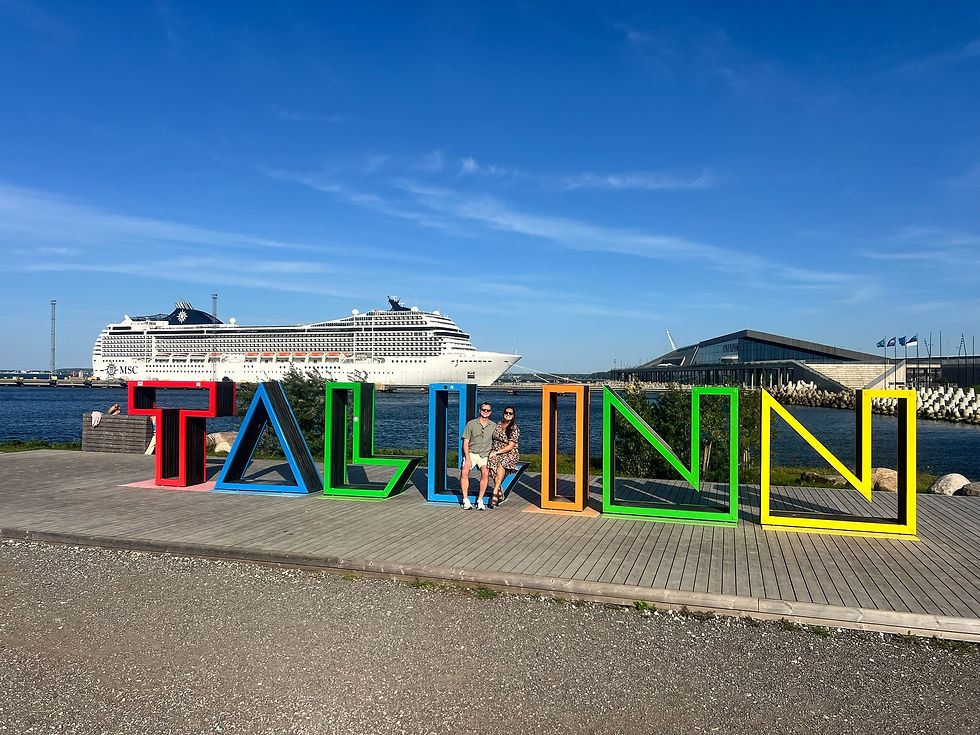
Tallinna tähed
As we made our way back to the ship, we stopped for a final photo op to end our time in the Baltic countries! Next stop: Finland and the Scandinavian countries!
Here's your daily dose of Hugo and Reynolds pictures! We really do have the best dog sitter out there!
Until next time,
--Katie


Comments